
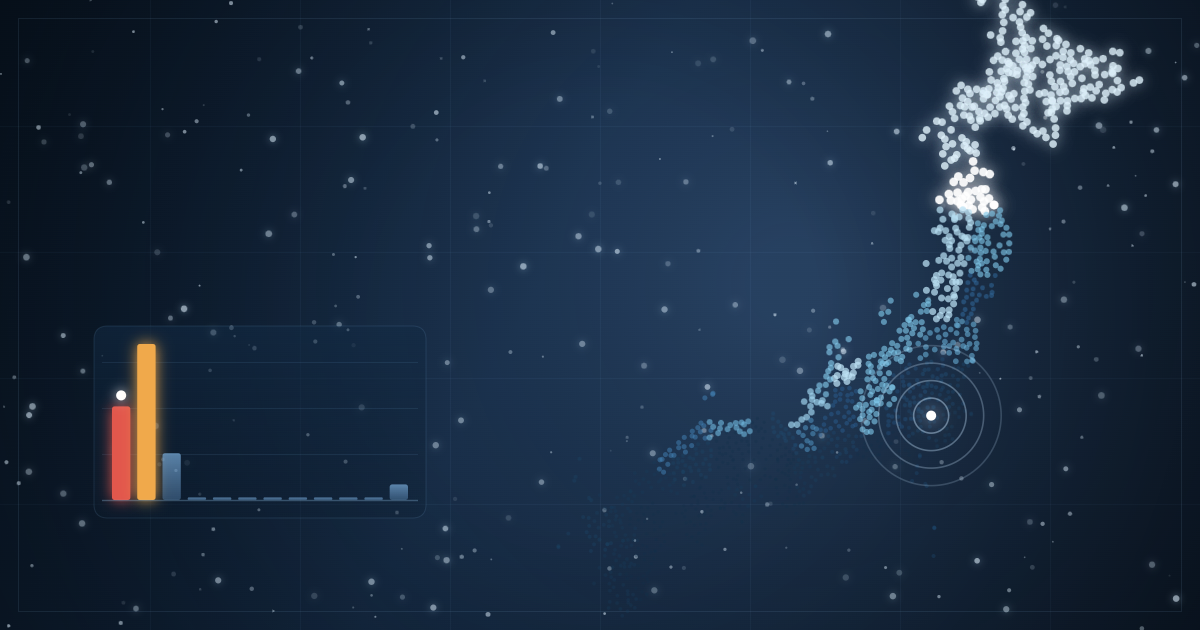
Yes, it snows in Tokyo, but not often and rarely much. Over 58 years of Japan Meteorological Agency records, snow was observed on 6% of January days, 10% of February days, 3% of March days and 1% of December days: about six days a winter, most of them a few flakes that never settle. Snow that actually covers the ground (1cm or more) happens on average two or three times a winter, and a fall of 10cm or more comes once every few years. The record for recent decades is 27cm on 8 February 2014, which paralysed the city for a day.
This page explains when Tokyo gets snow, why it is so rare for a city at the same latitude as Tehran and Los Angeles but which can still shut down over 5cm, what happens to trains and flights, the biggest snowfalls of the last 40 years, and where to go for guaranteed snow within two hours of the city.
- Snow days: January 6%, February 10%, March 3%, December 1% of days (1968 to 2025)
- Settling snow (1cm+): two or three times a winter on average; 10cm+ once every few years
- Biggest recent falls: 27cm (8 Feb 2014), 23cm (22 Jan 2018), 10cm (6 Jan 2022), 8cm (5 Feb 2024)
- Most likely dates: mid January to mid February, with a south-coast low in the forecast
- Guaranteed snow nearby: GALA Yuzawa (75 min by shinkansen), Nikko, Karuizawa, Hakone (sometimes)
Check the snow odds for your dates in Tokyo (58 years of records)
Set the window to plus or minus 7 days to see how often snow was recorded around your date, and open the recent-records list to see what the last dozen winters did.
How often does it snow in Tokyo, month by month?
| Month | Days with snow observed | Average high / low | Days below 0°C at night | Sunny days |
|---|---|---|---|---|
| December | 1% | 12.0 / 3.8°C | 3% | 67% |
| January | 6% (about 2 days) | 9.8 / 1.2°C | 15% | 70% |
| February | 10% (about 3 days) | 10.9 / 2.1°C | 12% | 61% |
| March | 3% (about 1 days) | 14.2 / 5.0°C | 1% | 51% |
February is the snowiest month, not January, even though January is colder. The reason is where the snow comes from, explained below. Compare with Sapporo (snow on 88% of January days), Kyoto (23%) or Kanazawa (53%) using the tool further down.
Why Tokyo gets so little snow, and why it can still get a lot at once
The winter monsoon dries the Pacific side. Tokyo’s winter weather is dominated by cold, dry north-westerly winds from Siberia. They dump their moisture as snow on the Sea of Japan side of the mountains (Niigata, Nagano, the Hokuriku coast) and arrive in Tokyo as clear, bone-dry air. That is why Tokyo is sunny on 67 to 70% of December and January days and gets only 60mm of precipitation a month: there is simply nothing left to fall.
South-coast lows are the snow makers. Tokyo’s snow comes almost entirely from low-pressure systems that track east along the Pacific coast of Honshu, usually between mid January and early March. They pull cold air down from the north over the Kanto plain and moist air in from the ocean. Whether that precipitation falls as rain, sleet or snow depends on a degree or two: forecasters look at the temperature about 1,500m up (below minus 4°C is the rule of thumb) and the surface humidity. Get the mix right and Tokyo can receive 20cm in a night; miss it by a degree and it is cold rain.
A city built for rain, not snow. Because settling snow happens two or three times a winter, Tokyo has almost no snow-clearing equipment, few winter tyres and millions of commuters on trains and bicycles. Five centimetres is enough to slow the rail network, close expressways and cause hundreds of slip injuries; twenty centimetres stops the city for a day. The same fall in Sapporo would go unremarked.
Tokyo’s biggest snowfalls since 1980
| Date | Depth in central Tokyo | What happened |
|---|---|---|
| 8 February 2014 | 27cm | Deepest since 1969; trains stopped, Narita cut off, a second 27cm fall a week later crippled Yamanashi and Saitama |
| 22 January 2018 | 23cm | Evening commute paralysed; expressways closed; hundreds injured on ice the next morning |
| 14 January 2013 | 8cm | Coming of Age Day snow; flights cancelled at Haneda |
| 6 January 2022 | 10cm | First 10cm fall in four years; snow and ice warnings for the first time in the new year |
| 5 February 2024 | 8cm | Evening snow turned to rain; trains slowed, expressways closed overnight |
| 24 January 2016 | 6cm | Heavy snow in Kyushu and Okinawa’s first sleet on record in the same cold outbreak |
What happens in Tokyo when it snows
- Trains: JR and private lines run at reduced speed and frequency; the Narita Express and some limited expresses are suspended in advance. The subway is the safest bet.
- Flights: Haneda and Narita cancel and delay hundreds of flights in a heavy fall, mostly domestic; international flights usually go a few hours late.
- Roads: expressways around Tokyo close as a precaution; taxis are scarce; bicycles are dangerous the morning after.
- The next morning: the ice is the real hazard. Pavements refreeze overnight and emergency rooms fill with slip injuries. Shoes with grip and a slow pace are essential.
- Sights: a snowy morning at Meiji Jingu, the Imperial Palace moat or Shinjuku Gyoen is rare enough that locals go out to photograph it; by afternoon it is usually gone.
Where to see guaranteed snow near Tokyo
| Place | Travel time from Tokyo | Snow season | Notes |
|---|---|---|---|
| GALA Yuzawa (Niigata) | 75 to 90 minutes by shinkansen | Mid December to early May | Ski resort with a station inside the building; rental gear; day trip |
| Nikko (Tochigi) | 2 hours | Late December to March | Shrines in snow; Kegon Falls partly frozen; Lake Chuzenji |
| Karuizawa (Nagano) | 65 minutes by shinkansen | December to March | Light snow, outlet mall, small ski area |
| Hakone | 90 minutes | January to February, not guaranteed | Snow on the upper ropeway and Owakudani; often none at the lake |
| Kusatsu Onsen (Gunma) | 3 to 4 hours | December to March | Hot spring town under deep snow; steaming yubatake |
| Jigokudani Snow Monkeys (Nagano) | 3 hours | December to March | Macaques bathing in an outdoor hot spring |
Compare Tokyo’s snow with other cities
The forecast phrase to look for is “rain or snow” with a low pressure system to the south. If the Japan Meteorological Agency issues a heavy snow warning for the 23 wards, the city will take it seriously: employers send people home early and trains thin out from the afternoon. It happens about once a winter and is, for a visitor with no train to catch, a beautiful day.
Frequently asked questions
Does it snow in Tokyo in December?
Almost never: snow is observed on about 1% of December days, typically a few flakes late in the month. Settling snow in December is rare enough to make the news.
What month is best for snow in Tokyo?
February, with snow observed on 10% of days, followed by January at 6%. The most likely window is mid January to mid February. Even then, most events are light.
How much snow does Tokyo get in a year?
The 1991 to 2020 average is about 8cm of total seasonal snowfall, with a maximum depth of a few centimetres in a typical winter. Several winters have no settling snow at all.
Will snow cancel my flight from Tokyo?
Heavy snow (10cm or more) cancels many domestic flights and delays international ones for a few hours; it happens once every few years. Light snow has little effect. Check your airline the evening before if a snow warning is out.
Is Tokyo colder than New York or London in winter?
No. Tokyo’s January average high is 9.8°C and low 1.2°C; New York averages 4°C / minus 3°C and London 8°C / 3°C. Tokyo is milder than New York and sunnier and drier than London.
- Yes, on about 6% of January and 10% of February days, mostly flurries; settling snow two or three times a winter
- It comes from south-coast lows between mid January and early March, not from the winter monsoon
- A 5cm fall disrupts trains and roads; 20cm stops the city for a day
- For guaranteed snow go to GALA Yuzawa, Nikko or Karuizawa, all under two hours away
Sources: Japan Meteorological Agency climatological normals (1991 to 2020) for temperatures, precipitation and sunshine; JMA daily observations 1968 to 2025 (58 years) compiled by this site for the share of sunny, rainy, snowy, hot and cold days. Written by a certified Japanese weather forecaster (気象予報士). Percentages are the share of days in the month; a 30 percent rain-day figure means roughly 9 days a month.